Haile Selassie: The Man Who Came Back

The Sunday People, Sun, Feb 02, 1941 ·Page 5
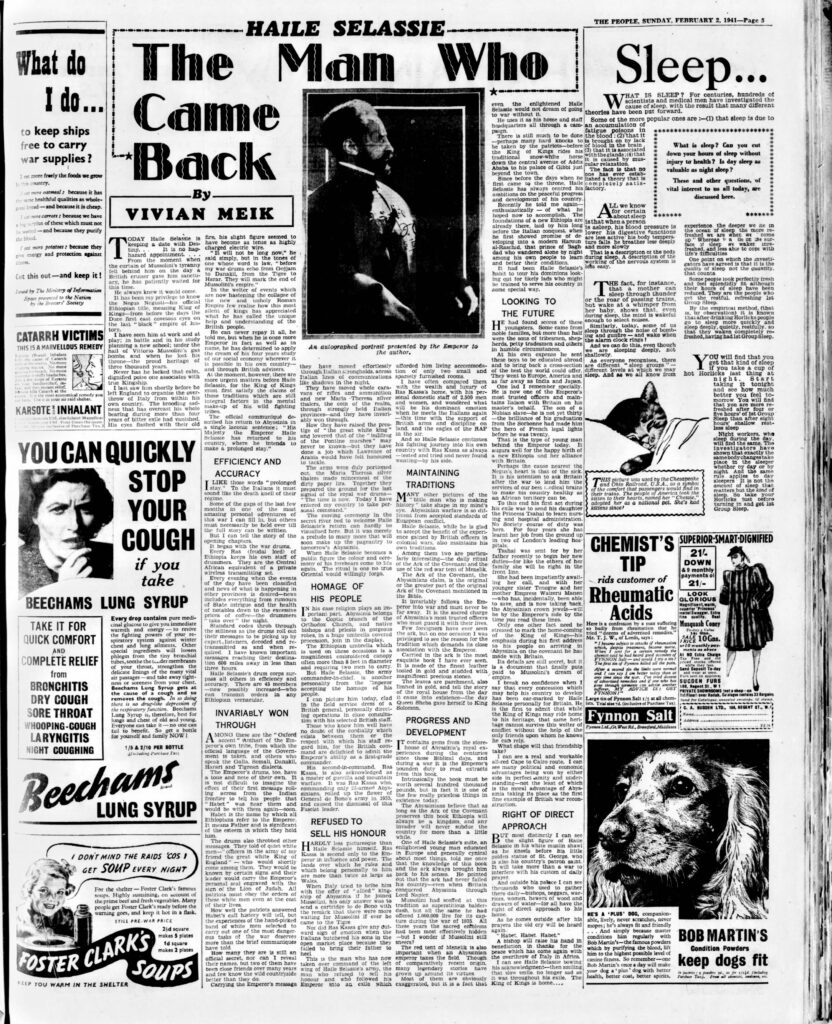
TODAY Haile Selassie is keeping a date with Destiny… It is no haphazard appointment…

From the moment when the curtain of Mussolini’s tyranny fell behind him on the day a British cruiser gave him sanctuary, he has patiently waited for this time.

He always knew it would come.

It has been my privilege to know the Negus Negusti – his official Ethiopian title, meaning King of Kings – from before the days the Duce first cast covetous eyes on the last “black” empire of history.

I have seen him at work and at play; in battle and in his study planning a new school; under the hail of Vittorio Mussolini’s gas bombs and when he lost his throne – the proud heritage of three thousand years.

Never has he lacked that calm, dignified poise one associates with true Kingship.
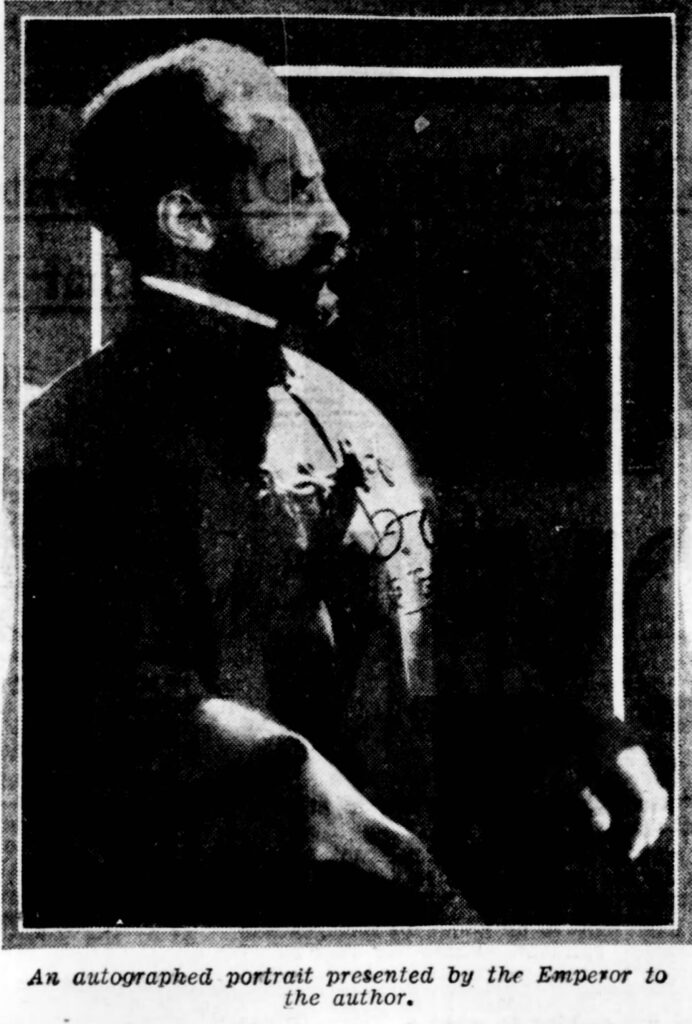
I last saw him shortly before he left England to organise the overthrow of Italy from within his own country. The brooding sadness that has overcast his whole bearing during more than four years of bitter exile had vanished. His eyes flashed with their old fire, his slight figure seemed to have become as tense as highly electric wire.

“It will not be long now,” he said simply, but in the tones of one whose word is law, “before my war drums echo from Gojjam to Danakil, from the Tigre to Harar. They will mark the end of Mussolini’s empire.”

In the welter of events which are now hastening the collapse of the new and unholy Roman Empire few realise how this most silent of kings has appreciated what he has called the unique help and understanding of the British people.

He can never repay it all, he told me, but when he is once more Emperor fact as well as in name, he has determined to apply the cream of his four years study of our social economy wherever it is possible in his own country – and through British advisers.

At the moment, however, there are more urgent matters before Haile Selassie, for the King of Kings must first satisfy the claims of those traditions which are still integral factors in the mental make-up of his wild fighting tribes.

The official communiqué described his return to Abyssinia in a single laconic sentence: “His Majesty the Emperor Haile Selassie has returned to his country, where he intends to make a prolonged stay.”

EFFICIENCY AND ACCURACY

I LIKE those words “prolonged stay”. To the Italians it must sound like the death knell of their regime

Some of the gaps of the last few months in one of the most amazing personal adventures of this war I can fill in, but others must necessarily be held over till the full story can be written. But I can tell the story of the opening chapters.

It began with the war drums.

Every Ras (feudal lord) of Ethiopia keeps his own staff of drummers. They are the Central African equivalent of a private wireless transmitting set.

Every evening when the events of the day have been classified and news of what is happening in other provinces is desired – news includes everything from rumours of State intrigue and the health of notables down to the excessive prices of coffee – the drummers “take over” the night.

Standard codes throb through the stiliness as the drums roll out their messages to be picked up by expert listeners, decoded and re-transmitted as and when required. I have known important messages reaching their destination 600 miles away in less than three hours.

Haile Selassie’s drum corps surpass all others in efficiency and accuracy. There are 45 members – now possibly increased – who can transmit orders in any Ethiopian vernacular.

INVARIABLY WON THROUGH

A MONG these are the “Oxford accent” Amhari of the Emperor’s own tribe, from which the official language of the Govern ment is taken, and others who speak the Galla, Somali, Danakil, Harari and Tigrean dialects.

The Emperor’s drums, too, have a tone and note of their own. It is not difficult to imagine the effect of their first message rolling across from the Indian frontier to tell his people that “Habet was near them and would be with them again – soon.

Habet is the name by which all Ethiopians refer to the Emperor. It means Father and is significant of the esteem in which they hold him.

The drums also throbbed other messages. They told of quiet white men – “officers in the army of my friend the great white King of England” – who would shortly come among them. They would be known by certain signs and their leader would carry the Emperor’s personal seal engraved with the sign of the Lion of Judah. All must obey the orders these white men even at the cost of their lives.

How well the patriots answered Habet’s call history will tell, but the experiences of the hand-picked band of white men selected to carry out one of the most dangerous tasks of the war deserves more than the brief communiqués have told.

How many they are is still an official secret, nor can I reveal their names, but two of them have been close friends over many years and few know the wild countyside better than they do.

Carrying the Emperor’s message, they have moved effortlessly through Italian strongholds, across Italian lines of communications like shadows in the night,

They have moved whole caravans of rifles and ammunition and new Maria Theresa silver thalers, the coin of the realm, through strongly held Italian provinces and they have invariably won through.

How they have raised the prestige of “the great white king” and lowered that of the “bullfrog of the Pontine marshes” may never be known – but they have done a job which Lawrence of Arabia would have felt honoured to tackle.

The arms were duly portioned out, the Maria Theresa silver thalers made mincemeat of the dirty paper lira. Together they prepared the ground for the last signal of the royal war drums – “The time is now. Today I have entered my country to take personal command.”

The moving ceremony in the secret river bed to welcome Haile Selassie’s return can hardly be visualised here. But it was merely a prelude to many more that will soon make up the pageantry to tomorrow’s Abyssinia.

When Haile Selassie becomes a public figure the colour and ceremony of his forebears come to life again. The ritual is one no true Oriental would willingly forgo.

HOMAGE OF HIS PEOPLE

IN his case religion plays an important part. Abyssinia belongs to the Coptic branch of the Orthodox Church, and native bishops and priests in gorgeous robes, in a huge umbrella covered procession, join in the display.

The Ethiopian umbrella which is used on these occasions is a magnificent embroidered canopy often more than 8 feet in diameter and requiring two men to carry.

But Haile Selassie, the army commander-in-chief, is another personality from the Emperor accepting the homage of his people.

I can picture him today, clad in the field service dress of a British general, personally directing operations in close consultation with his selected British staff.

Those who know him well have no doubt of of the cordiality which exists between them or the respect with which his staff regard him, for the British command are delighted to admit the Emperor’s ability as a first-grade commander.

His second-in-command, Ras Kassa, is also acknowledged as a master of guerilla and mountain warfare. It was Ras Kassa who, commanding only ill-armed Abyssinians, rolled up the flower of General de Bono’s army in in 1935 and caused the dismissal of this Fascist leader.

REFUSED TO SELL HIS HONOUR

HARDLY less picturesque than Haile Selassie himself, Ras Kassa is second only to the Emperor in influence and power. The lands over which he rules and which belong personally to him are more than twice as large as Wales.

When Italy tried to bribe him with the offer of “allied” kingship of Abyssinia if he joined Mussolini, his only answer was to send a cartridge to de Bono with the remark that there were more waiting for Mussolini if ever he came to the Tigre.

Nor did Ras Kassa give any outward sign of emotion when the Italians butchered his sons in the open market place because they failed to bring their father to heel.

This is the man who has now taken over command of the left wing of Haile Selassie’s army, the man who refused to sell his honour and who followed his Emperor into an exile which afforded him living accommodation of only two small and sparsely furnished rooms.

I have often compared them with the wealth and luxury of Ras Kassa’s home, with his personal domestic staff of 2,500 men and women, and wondered what be his dominant emotion when he meets the Itallans again – this time with the support of British arms and discipline on land, and the the eagles of the RAF in the air.

And so Haile Selassie continues his fighting journey into his own country with Ras Kassa as always – tested and tried and never found wanting – by his side.

MAINTAINING TRADITIONS

MANY other pictures of the “little man who is making history” take shape in my mind’s eye. Abyssinian warfare is so different from accepted standards of European conflict.

Haile Selassie, while he is glad to accept the benefit of the the experience gained by British officers in colonial wars, also maintains his own traditions.

Among them two are particularly interesting – the daily ritual of the Ark of the Covenant and the use of the red war tent of Menelik.

The Ark of the Covenant, the Abyssinians claim, is the original or the greater part of the original Ark of the Covenant mentioned in the Bible.

It invariably follows the Emperor into war and must never be far away. It is the sacred charge of Abyssinia’s most trusted officers who must guard it with their lives.

Few foreigners have ever seen the ark, but on one occasion I was privileged to see the reason for the tradition which demands its close association with the Emperor.

Carried in the ark is the most exquisite book I have ever seen. It is made of the finest leather tooled in gold and studded with magnificent precious stones.

The leaves are parchment, also limned in gold, and tell the story of the royal house from the day it came into existence the day Queen Sheba gave herself to King Solomon.

PROGRESS AND DEVELOPMENT

It contains gems from the storehouse of Abyssinia’s royal experiences during the centuries since those Biblical days, and during a war it is the Emperor’s bounden duty to read extracts from this book.

Intrinsically the book must be worth several hundred thousand pounds, but in fact it is one of the few really priceless things in existence today.

The Abyssinians believe that as long as the Ark of the Covenant preserves this book Ethiopia will always be a kingdom, and any invader will never subdue the country for more than a little while.

One of Haile Selassie’s suite, an enlightened young man educated in Europe and generally cynical about most things, told me once that the knowledge of this book and the ark always brought him back to his senses. He pointed out that the ark had never failed his country – even when Britain conquered Lord Napier.

Mussolini had scoffed at this tradition as superstitious balderdash, but all the same he had offered 1,000,000 lire for its capture during the war of 1935. All these years the sacred emblems had been most effectively hidden – but I wonder if Mussolini still sneers?

The red tent of Menelik is also important when an Abyssinian emperor takes the field. Though of comparatively recent origin, many legendary stories have grown up around its virtues. Most of them are obviously exaggerated, but it is a fact that even the enlightened Haile Selastic would not dream of going to war without it.

He uses it as his home and staff headquarters all through a campaign.

There is still much to be done – perhaps many hard knocks to be taken by the patriots – before the King of Kings rides his traditional snow-white horse down the central avenue of Addis Ababa to his palace of Gibhi just beyond the town.

Since before the days when he came to the throne, Haile Selassie has always centred his ambitions on the peaceful progress and development of his country.

Recently he told me again – enthusiastically – of what he hoped now to accomplish. The foundations of a new Ethiopia are already there, laifd by him lnog before the Italian conquest, when he first showed promise of developing into a modern Haroun al-Raschid, that prince of Baghdad who wandered alone by night among his own people to learn and better their conditions.

It had been Haile Selassie’s habit to tour his dominions looking out for likely lads who might be trained to serve his country in some special way.

LOOKING TO THE FUTURE

He had found scores of these youngsters. Some came from noble familles, but more than half were the sons of tribesmen, shepherds, petty tradesmen and others in humble circumstances.

At his own expense he sent these boys to be educated abroad and to bring back a cross-section of the best the world could offer.

They went to Europe, America and far away as as India and Japan. One lad I remember specially. He is now one of the Emperor’s most trusted officers and main Nubian slave – he is not yet thirty -the brilliance of his graduation from the Sorbonne had made him the hero of French legal lights before he was twenty.

That is the type of young man behind the Emper today. It augurs well for the happy birth of a new Ethiopia and her alliance with Britain.

Perhaps the cause nearest the Negus’s heart is that of the sick. It is his intention to ask Britain after the war to lend him the services of our best medical brains to make his is country healthy as an Afriran territory can be.

To this end his first act during his exile was to send his daughter the Princess Tsahai to learn nursing and hospital administration. No Society course of duty was hers. For four years she has learnt her job from the ground up in two of London’s leading hospitals.

Taahal was sent for by father recently to begin her new duties – for like the others of her family she will be right in the front line.

She had been impatiently awalting her call and with her younger sister Tenogne and her mother Empress Waizeru Manen – who has, incidentally, been able to save, and is now taking back, the Abyssinian crown jewels – will be by the Emperor’s side by tyhe time you read these lines.

Only one other fact needs be streased to mark the home-coming of the King of Kings – his emphasis during his first address to his people on arriving in Abyssinia on the covenant he hat made with Britain.

Its details are still secret, but it is a dicument that finally puts paid to Mussolini’s dream of empire

I break no confidence when I say that every concession which may help his country to develop has been earmarked by Haile Selassie personally for Britain. He is the first to admit that while the King of Kings may ride home to his heritage, that came heritage cannot survive this welter of conflict without the help of the only friends upon whom he knows he cann rely.

What shape will that friendship take?

I can see a real and workable all-red Cape to Cairo route. I can see many political and economic advantages being won by either side in perfect amity and understanding- not the least of which is the moral advantage of Abyssinia taking its place as the first fine example of British war reconstruction.

RIGHT OF DIRECT APPROACH

BU most distinctly I can seethe slight figure of Selassie in his white muslin shawl as he kneels before his little golden statue of St. George who is also his country’s patron saint. It will take more than a war to interfere with his custom of daily prayer.

And outside his palace I can see thousands who used to gather there daily-bishops, beggars, warriors, hewers of wood and drawers of water-for all have the right of direct approach to his home.

As he comes outside after his prayers the old cry will be heard again.

“Habet, Habet, Habet.”

A bishop will raise his hands in benediction in thansk for the peace which has come again with the overthrow of Italy in Africa.

I can see Haile Selassie bowing his acknowledgement – then smiling that slow smile no longer sad as it was throughout his exile. The King of Kings is home….

Addia Ababa Falls Today – Haile Selassie Protected by France at Djibouti

Nevada State Journal, Mon, May 04, 1936 ·Pages 1-2

Haile Selassie protected by France at Djibouti

King of Kings and 20 Others Flee From Addis Ababa

DJIBOUTI, French Somaliland, May 8-(UP)-Emperor Haile Selassie of Ethiopia, who arrived here this afternoon with members of his family, will sail tomorrow morning on the British destroyer Diana for Aden, Arabia.

Late reports reaching here said all of Ethiopia not held by Italians except Diredawa was in chaos with powerful chiefs fighting for control.

Italian troops reportedly have smashed through Ras Nasibu’s army on the southern front to occupy Jijiga.

Emperor Halle Selassie was beaten by his own countrymen and not by the Italians, Edward Beattie, United Press staff correspondent at Addis Ababa until recently, says in the following dispatch. Beattie served at the Ethiopian capital longer than any other American correspondent.

**

DJIBOUTI, French Somaliland, May 8.-(U.P)-Emperor Haile Selassie and members of the imperial family of Ethiopia, accompanied by leading generals and government officials, arrived here today.

They fled by train from Addis Ababa yesterday.

Pending decision as to their future movements they are guests at the palace of the governor of French Somaliland.

BRITISH DESTROYER ARRIVES

Although the British destroyer Diana has arrived here it is not believed the vessel will be boarded by the emperor.

The emperor, Empress Menen, Crown Prince Asfa Wosan, Prince Makonnen and Princess Tesahai arrived at 2:15 p.m. after abandoning their capital at Addis Ababa to a reign of terror.

Arriving with the Emperor were Ras Kassa, former commander of an Ethiopian northern army, Foreign Minister Herouy and his wife, Ras Desta Demtu, son-in-law of the emperor whose troops were defeated in southern Ethiopia, and others.

MILITARY HONORS

The imperial party included 21 men, women and children.

Djibouti was filled with French troops, whites and colonials, when the emperor and his suite arrived. Drastic precautions were taken against demonstrations.

At the railway station full military honors were accorded the fugitive King of Kings.

An Italian photographer attempted to photograph the imperial family. He was attacked and beaten by Eth-iopian bystanders but there were no repercussions to the incident.

TRIP, WITHOUT FOOD

Automobiles placed at their disposal by the French Somaliland government conveyed the fugitives to the palace. They said that during the trip from Addis Ababa they were without food.

From the railway station to the palace long lines of troops pushed back thousands of curious, struggling for a view of the Ethiopian refugees.

The emperor and those accompanying him were worn and haggard.

“They are in misery.” people lining the streets cried as the motor-cars carrying the imperial family sped past.

“SAD AND WEARY”

Upon arrival at the governor’ palace the emperor went into seclusion. He was seen only by French officials. His majesty expressed a desire to sleep.

When he left his train the emperor stood between his two sons. The empress, following the negus and the princes, was heavily veiled.

French officials who saw the empress at the governor’s palace said that “she was sad-faced and weary.”

She, in her white robes, was silent.

So was the emperor.

His majesty shook hands with the French governor and his chief military aides.

CROWN PRINCE SUBDUED

The empress scarcely noticed the throngs watching the arrival of the family representing one of the few remaining of the world’s absolute monarchies.

The fugitive emperor and his empress walked slowly between the guards provided by an alien power – France, whose language they speak.

French Senégalese troops stood at attention with fixed bayonets.

The crown prince, who has been accused of readiness to cast his lot with the Italians and become the puppet ruler of Ethiopia, was as mild as goose milk in the presence of his imperial parents.

ONLOOKERS WEEP

He stood with the imperial party in burning French Somaliland sunshine while women in the crowd, women of all nationalities, broke down and wept.

Onlookers, there as a matter of curiosity, also wept.

But the emperor was stoical. He drove off to a bed in the palace of a friendly nation, as though he were proceeding to an audience from his own throne.

British Concerned by Haile’s Fate; Continuation of Sanctions Demanded

LONDON, May 3.-(U.P.)-Great Britain today entered into urgent consultations with France to discuss the fate of the fugitive emperor of Ethiopia, Haile Selassie.

The British are vitally interested also, in holding together the League of Nations sanctionist front against Italy.

Foreign Minister Pierre-Etienne Flandin of France has been asked to consider preparations for the May 11 League council meeting, with British Foreign Secretady Anthony Eden.

The latest message from Sir Sidney Barton, British minister to Ethiopia, said the situation in Addis Ababa “is somewhat quieter.” After hours of pillage, fire and murder, he said, the city is being evacuated by the natives.

One British casualty has been reported. Barton has been advised that the Diana has arrived at Djibouti to aid in maintaining communication between the beleaguered British legation at Addis Ababa and the foreign office in Whitehall. It will also maintain communication for the British consul at Djibouti.

It is understood that during consultations with the French, Eden intimated that in his opinion the question of interning the king of kings will not arise. Not only because of the emporer’s rank but because he is a virtual ally of the League of Nations powers.

Barton informed the government that before fleeing Addis Ababa the emperor handed over the reins of government to his ministers. Thus, experts regard his act as tantamount to de facto abdication. However, officials consider that Haile Selassie has not yet formally abdicated.

Competent British quarters emphasized that the future destiny of the Negus depends not only on the French government but on his own wishes.

Unofficial but well informed sources denied that the Anglo-Franco consultations, proceeding both in Paris and London, so far have envisaged a tri-power conference, including Italy, “to give up Ethiopia’s corpse.”

The Ethiopian legation received no word from Addis Ababa today, but a spokesman reiterated the belief that Emperor Haile Selassie, after escorting the royal family to French Somaliland, will return to Ethiopia to establish a government seat elsewhere and continue to direct his troops.


Haile Selassie Beaten by His Own Countrymen, Says United Press Man; Every Effort at Progress Defeated

By EDWARD BEATTIE

NEW YORK, May 3-(UP)-Haile Selassie I, who took his last chance for freedom as the Italian pincers closed and revolt swept in from the west, failed as ruler of Ethiopia because he was too good for his country.

He has no European education like the young men he has yearly sent abroad to absorb civilized ideas and technique. His entire education came from an old French priest in Harar, where his father, Ras Makonnen, was governor during his boyhood.

MASS IGNORANCE

He himself supplied the vision, industry and moral courage which he pitted for years as regent and since 1930 in his own right against a weight of barbarism, cruelty, mass ignorance and indifference prevalent in feudal Ethiopia.

He was balked everywhere. When he tried to educate technicians abroad he was forced to do so out of his own pocket, because priests and advisors blocked spending public money on “Farengi civilization.”

When he brought the first air plane to Ethiopia during the reign of the Empress Zaouditu, it was shipped back to Djibouti posthaste because the priests convinced the empress man was not made to fly and the plane must therefore be the devil’s work.

PHONE WIRE STOLEN

When he tried to lay telephone lines the wires were stolen by natives to stick in their noses or ears ornaments. Grafting ministers sold to their own advantage the rifles and machine guns which he attempted to lay in against the Italian invasion he knew was coming.

His whole reign was a repitition of the same thing. With the exception of a half dozen young pro-worked and whose enthusiasm was offset by their ineptitude, no one in Ethiopia cared whether civilization progressed or not and at least 50 per cent of the powerful chiefs openly opposed it.

Haile Selassie knew war probably meant the end of him and his attempted progress. Even if he had held the Italians off and eventually gained peace, he was through as dictator. He had remained the supreme power, like all Ethiopian rulers because he “had the big guns,” in this case guns that would really shoot.

When war threatened he distributed them among his chiefs, many of them openly hostile to his program and others sympathetic to the old dynasty which considered him a usurper. If peace had come, he would probably have faced revolt.

FORCED TO TAKE FIELD

He was forced to refuse all concessions when peace efforts were made because to make them would have meant revolution in the north. Totally unfitted for military command, he was forced to take the field when he would have been much more effective at Addis, organizing supply and directing both fronts from a central point.

He knew that guerilla warfare was Ethiopia’s only chance – that through it he might make the war so expensive and long-drawn that Italy would be content with part, rather than all, of Ethiopia.


French Legation In Addis Ababa Attacked by Mobs

PARIS, May 3.-(U.P.) The French legation at Addis Ababa was attacked by rioting throngs of maddened Ethiopians today.

Hundreds of Italian prisoners of war, entrusted by Emperor Haile Selassie to the custody of the French pending the imminent Italian occupation, roused the lust for blood of thousands of Ethiopians to fever pitch.

TWO ATTACKS REPULSED

M. Bodard, French minister to the deserted Ethiopian court, reported that twice the handful of defenders at his legation repulsed two violent attacks by armed mobs.

Two foreigners were wounded.

Earlier two Armenians under French protection were killed and several injured in a similar attack.

Bodard reported that pillagers burned the French railway warehouses in Addis Ababa with losses totalling millions of francs.

Bodard’s messages, crackling over his legation radio station, caused grave concern in Paris.

France at once appealed to Premier Benito Mussolini to protect, foreigners in Addis Ababa.

Mussolini informed the Paris, London and other governments that Marshal Pietro Badoglio, Italian commander-in-chief in East Africa, has been ordered to hasten his entry into Addis Ababa to assure the safety of foreigners.

Bodard reported the urgent necessity of Italian help against bands of Ethiopian looters and disorganized, undisciplined soldiers.

1200 IN COMPOUND

He said the French legation compound in the terror-stricken city was giving refuge to 1200 French, Czechoslovakian and Spanish refugees. Mobs, Bodard wirelessed, were determined to demolish the capital before the Italians arrived.

Delayed messages from Bodard reported that he visited the emperer before the imperial family fled to Djibouti. The Negus asked that France insure his security upon arrival at the French port. Bodard pledged that such security would be given.

OPEN LINE IN LEGATION

Subsequently the diplomatic corps in Addis Ababa asked the emperor not to attempt the defense of his capital so as to avoid a battle which would risk the lives of foreigners.

Prior to his departure, the emporer turned hundreds of Italian prisoners of war over to Bodard’s custody. He asked him to deliver the prisoners to Badoglio.

In his messages to Paris Bodard appealed for news of Badoglio’s whereabouts. He reported soldiers and bandits opened fire on his legation as soon as they learned Italian prisoners were in Bodard’s custody

PALACE LOOTED

Bodard reported that pillagers sacked the Imperial palace after the guard had mowed down many with machine gun fire. Others burned the downtown section of the capital

The young Ethiopian political party sent a warning to Bodard that he might expect further attacks on the French legation Sunday night.

When bullets started falling inside the French compound Saturday Bodard ordered a state of siege. He armed the refugees under his protection and stationed them to hold the walls of the compound at all cost.

ARMENIANS KILLED

Women and children were placed in deep caves for safety. The caves were dug months ago for just such an emergency as now prevails.

In a message timed Saturday midnight, Addis Ababa time, Bodard said that stray bullets killed two Armenians seeking refuge at the French legation. Several refugees were injured.

Literally thousands of bullets struck the legation walls.

Several French railroad officials were cut off from the legation compound and took refuge in the railway station. They were surrounded by mobs trying to burn the depot.


American Women, Children Rushed to Safety in Capital City of Ethiopia; Americans Leave Legation When Blacks Run Wild

Editor’s Note: The following eye-witness dispatch from Ben Ames, United Press correspondent at Addis Ababa, vividly describes the perils to foreigners in the capital Emperor Haile Selassie abandoned when he fled to the safety of French Somaliland. Ames and James R. Rohrbach, also of the United Press, are the only two American newspapermen in the stricken city. Ames was slashed with sabers when he fought his way through mobs of blood-crazed blacks to reach the compound from where this dispatch was sent.

BY BEN AMES

ADDIS ABABA, May 3. (U.P.)-Women and children of the United States legation were rushed through the streets of this sacked and fire-scarred capital in trucks tonight to the safety of the fortified British legation.

The wife of U. S. Minister Cornelius Van H. Engert was the only woman remaining with us in the compound.

U. S. WOMAN KILLED

Engert’s action in evacuating the women and children followed two days of murder and rioting by Ethiopions loosed from all restraint with the flight of Emperor Haile Selassie.

Mrs. A. R. Sartin, American woman missionary, was killed yesterday by a stray bullet as she slept.

A Dr. Melly, chief of the British Red Cross in Ethiopia, was shot in the lungs today while dragging in wounded from the street. He was given blood transfusion and it was believed he would survive. Shiftas, Ethiopian bandits, attacked T. A. Lambie, head of the Ethiopian Red Cross mission at the mission headquarters, but he beat them off.

12 DIE IN ATTACK

Lambie killed one and wounded another of his attackers.

The Turkish legation was attacked this afternoon. THe attackers finally fled, leaving 12 dead.

The servant of James Rohrbaugh, the other United press correspondent here, was shot through the leg and a tire of his motorcycle was punctured as he fled from a mob.

ITALIANS NEAR

A bullet passed through the windshield of the car in which several other correspondents and I made an inspection tour late today.

Italian troops were reported camped on Akaki plain, 10 miles from the city. White flags were flying on all the Ethiopian huts on the route into the capital.

The government gold house was the scene of a desperate fight. A drunken, infuriated mob stormed machine gun posts and fought hand to hand with the gold house defenders. Swarming over the corpses of their countrymen and the bodies of gravely wounded defenders, the mob entered the house and captured the gold stores.

Numerous bandits, carrying their loot to the nearby hills, were attacked by rebellious Galla tribesmen surrounding Addis Ababa.

Several small groups of Gallas have entered the city, armed only with spears. Their women, dressed as men, brandished sabers and prepared to fight side by side with their warrior husbands.

At dusk, the city started to quiet down. The streets were deserted for the first time in 36 hours.

Packs of wild dogs prowled about devouring mutilated corpses.

It was estimated that more than a half million bullets were fired by natives during the last 36 hours.

RAIN MAY SLOW RESCUE

It is raining here tonight, and this notorious Ethiopian rain may impede the Italian advance enough to postpone temporarily the fall of Addis Ababa.

“I have been barricaded for hours in my own compound near the government radio station. The station has closed. All normal existence in Addis Ababa has ceased since Emperor Haile Selassie fled to neutral territory and left the capital to the mercy of his tribesmen.

CORPSES COVER STREETS

“We were driven out of our compound by “Shiftas” the Ethiopian name for bandits. We were subjected to constant attacks from them. There are rumors now that the Shiftas have formed some sort of loose organization and are preparing for some serious efforts.

“I got to the center of the city. Streets are strewn with corpses. I counted eight bodies all of them mutilated – but there is no way of estimating how many have died in the rioting.

“The entire retail business section in the center of the city is in ruins. The postoffice is a heap of hot ashes and smouldering timber. The customs house is demolished.


Italians Closely Follow Advance Of Negro Troops

By REYNOLDS PACKARD

WITH THE ITALIAN ADVANCE ON ADDIS ABABA, transmitted via wireless at Derba Sina, May 3-(UP)-Marshal Pietro Badoglio, commander of Italy’s east African armies, tonight was following closely the native Askari troops which have occupied the Entoto hills overlooking Addis Ababa.

Marshal Badoglio is in constant contact with the vanguard of Italian troops and is personally directing the advance on Addis Ababa, He was expected momentarily give the order to enter the capital.

Badoglio’s motorized column of 1,000 units ploughed over the last muddy summit and reached the table land on which Emperor Haile Selassie’s capital is perched, 90 miles south of the positioin from which I am writing this dispatch. However, the huge mechanized column must travel at more than least 120 miles over tortuous roads to reach its goal.

On several occasions during the record-breaking advance, I have seen Marshal Badoglio wash and bathe in the rivers like any buck private and trudge for hundreds of yards on muddy, rocky roads in order to lighten the burden of his automobile.

Late last night the Marshal ordered his troops to pitch camp here in the little village of Derba Sina, below the edge of the plateau. Black shepherdesses gathered around the Italian camp and sang all night as a sign of welcome to the Fascist legions.

Meanwhile, a few miles to either side of the column glowed the campfires of disbanded Ethiopian warriors, apparently returning their distant farmlands after many months of suffering at the front in a vain attempt to halt the black shirts.